
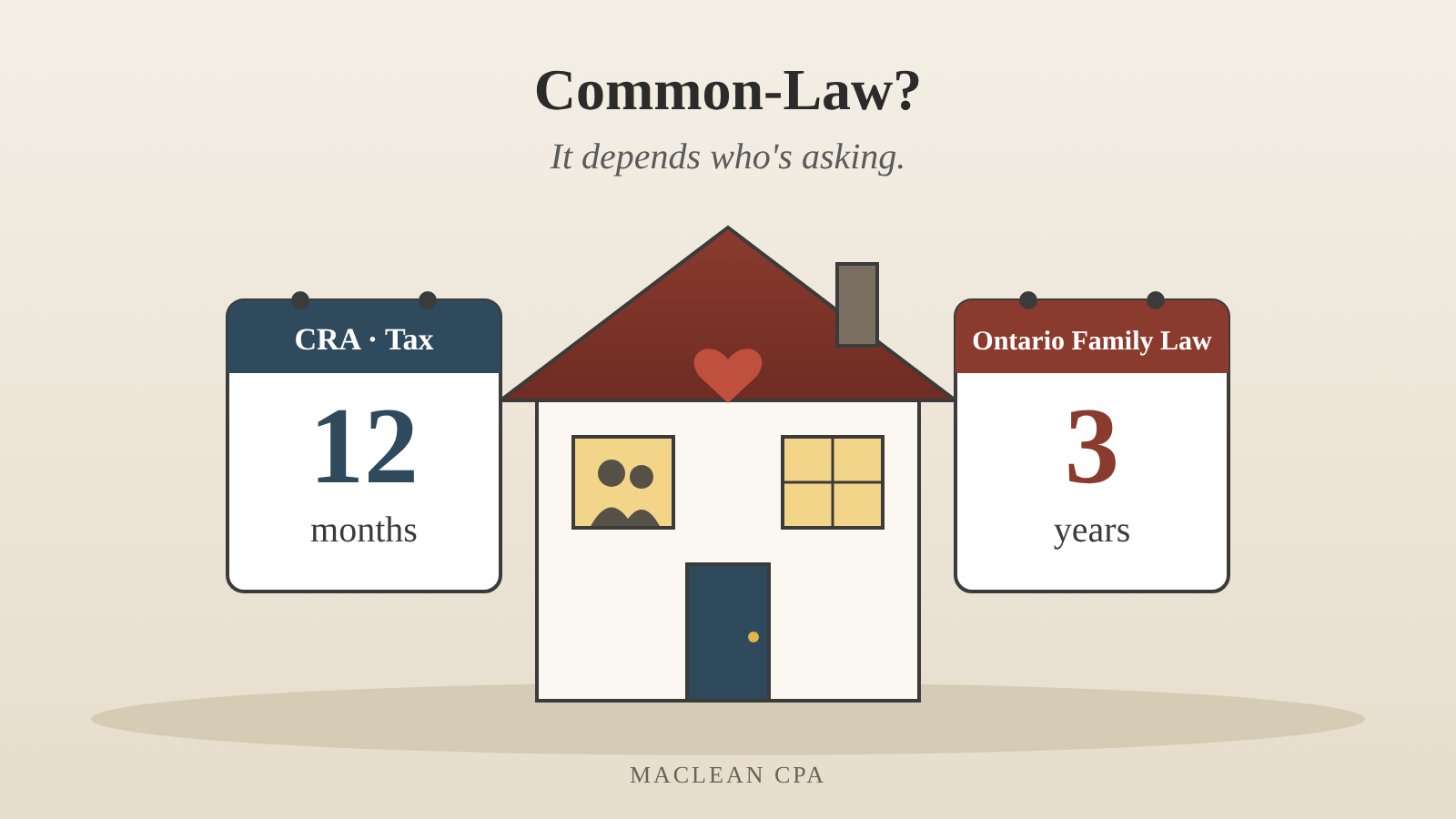
Every spring I ask a simple question on the personal tax organizer: What is your marital status? And every spring a few clients pause, because the honest answer is "it depends who's asking."
That's not a dodge. In Ontario, the Canada Revenue Agency and our family law system each have their own definition of a common-law partner, and they don't line up. You can be common-law for tax purposes after one year and still not be a "spouse" under Ontario family law for another two. That gap catches people off guard, sometimes at tax time and sometimes, far more painfully, at separation.
The CRA's clock: 12 months
For income tax, you are living common-law if you are in a conjugal relationship with someone you aren't married to and at least one of these applies (CRA):
- you have lived together for 12 continuous months;
- the person is the parent of your child by birth or adoption; or
- the person has custody and control of your child, and your child depends on them for support.
Note the third bullet. If you move in with someone who has kids and you're supporting them, you can be common-law on day one. No waiting period.
The CRA also has a rule for the other end of the relationship. You're only considered separated once you've lived apart for at least 90 days because the relationship broke down. A short cooling-off period doesn't change your status, and neither does living apart for work, school or health reasons. Once you pass 90 days, your separation date reaches back to the day you moved out. Status changes must be reported to the CRA by the end of the following month.
Why it matters on your tax return
The CRA treats common-law partners exactly like married spouses, which cuts both ways:
- Benefits get recalculated. The GST/HST credit, Canada Child Benefit and Ontario Trillium Benefit are based on family net income. A new partner's income can shrink or eliminate them, and the CRA will claw back overpayments if you report late.
- Some credits move to one person. You can no longer claim the eligible dependant ("equivalent to spouse") credit for a child, and only one home in the household can be your principal residence for capital gains purposes.
- New planning opens up. Spousal RRSPs, pension income splitting, the spousal amount, and tax-free rollovers of property to a partner on death all become available.
The mistake I see most often isn't fraud. It's simply not updating the status. A couple moves in together, both keep filing as single, and two or three years later the CRA reassesses the benefits with interest. That's an expensive letter to open.
Ontario family law's clock: 3 years
Ontario's Family Law Act doesn't use the phrase "common-law" at all. For support purposes, unmarried partners are treated as spouses if they have lived together continuously for at least three years, or if they're in a relationship of some permanence and have a child together (CLEO).
The bigger surprise is property. The equalization of net family property that applies to married couples on separation doesn't apply to common-law partners, no matter how long they've been together. In general, each partner keeps what's in their own name, and only jointly owned property is split. A partner who contributed to a home on the other's title can still make a trust or unjust enrichment claim, but that means litigation, not an automatic entitlement.
The same is true on death. If there's no will, Ontario's intestacy rules don't give a common-law partner a share of the estate. They'd have to apply to the court for dependant support. Wills and beneficiary designations matter even more for unmarried couples.
The bottom line
Picture a couple who has lived together for two years. The CRA has considered them common-law for a full year, so their benefits are based on combined income. Yet under Ontario family law, neither has a right to spousal support yet, and neither will ever get automatic property sharing unless they marry or sign an agreement.
A few practical steps:
- Update your marital status with the CRA within a month of hitting the 12-month mark, or the day a child is involved.
- If you're buying a home or merging finances, talk to a family lawyer about a cohabitation agreement.
- Review your will and your RRSP, RRIF, TFSA and insurance beneficiaries.
I handle the tax side; a good family lawyer handles the rest, and the best outcomes come when we're both in the loop. If you're not sure how your status should be reported, give us a call before you file.
This post is general information only and isn't legal advice. Speak with a family lawyer about your own situation.


Contact us today for a free consultation
Contact us today to learn more about how our accounting services can benefit your business. We look forward to hearing from you and helping you achieve financial success!

